I Love Gait:
The Biomechanics of Gait Made Clear
November 3 – December 19, 2025
Yoga teachers everywhere are asking questions like:
- “What does it mean if a student’s hips hike when they walk?”
- “Can I help someone reduce their limp after a knee replacement with yoga?”
- “How can I help my student not have back pain when they are walking?”
- “How can I help my students feel more steady when they walk?”
If you’ve ever wished you had a clear, reliable way to answer them, you’re not alone
But there is a gap.
The questions above … they are ultimately questions about how the body and nervous system actually coordinate walking.
What you are seeing is that something is off ….
The limp, the hip hike, the wobble, the fatigue. You know there’s more going on beneath the surface, but connecting what you’re noticing to what’s really driving it? That’s the missing link.
Without a clear structure that honours nervous system and biomechanics, you’ll find yourself to second-guessing what you’re seeing… which will lead you to reach for the fastest explanation.
These quick answers feel satisfying in the moment . . . but they rarely solve the real problem.
Here are 2 Examples of Common Assumptions
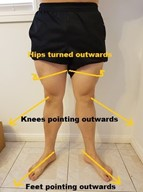
Feet turned out? Must be tight rotators.
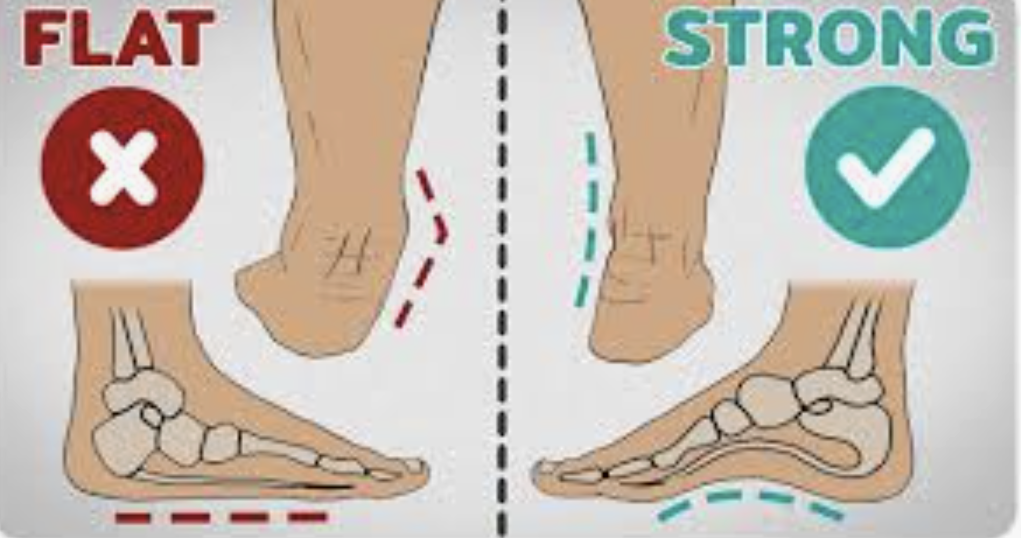
Arches collapsed? Must be weak feet.
The focus narrows to a single part, a single label, and an attempt to “fix” that one thing.
That doesn’t tend to have sustainable results.
At best, it may offer a short-term change.
But the deeper issue keeps showing up . . . the limp returns, the hip keeps hiking, the back still tightens.
Because what’s really driving the pattern hasn’t been addressed.
And there’s another issue too.
So many teachers are told: “Just try it in your own body so you can feel what your client feels.”
It sounds reasonable, but your body isn’t theirs. And when you project a made-up pattern onto them, you stop truly observing. You miss the real story their nervous system, joints, and tissues are telling.
That’s why so many teachers feel stuck . . . trying to help, but circling inside quick fixes that don’t create lasting change.
Welcome to I Love Gait
This is where the guessing ends.
In I Love Gait, you’ll learn how to:
Spot the biomechanical patterns that make walking harder than it needs to be.
Understand what contributes to limps, wobbles, or hip hikes.
Guide students toward smoother, steadier movement, without piling on more cues.
You don’t need to memorize an anatomy chart.
You just need to learn how to see gait in a way that makes sense
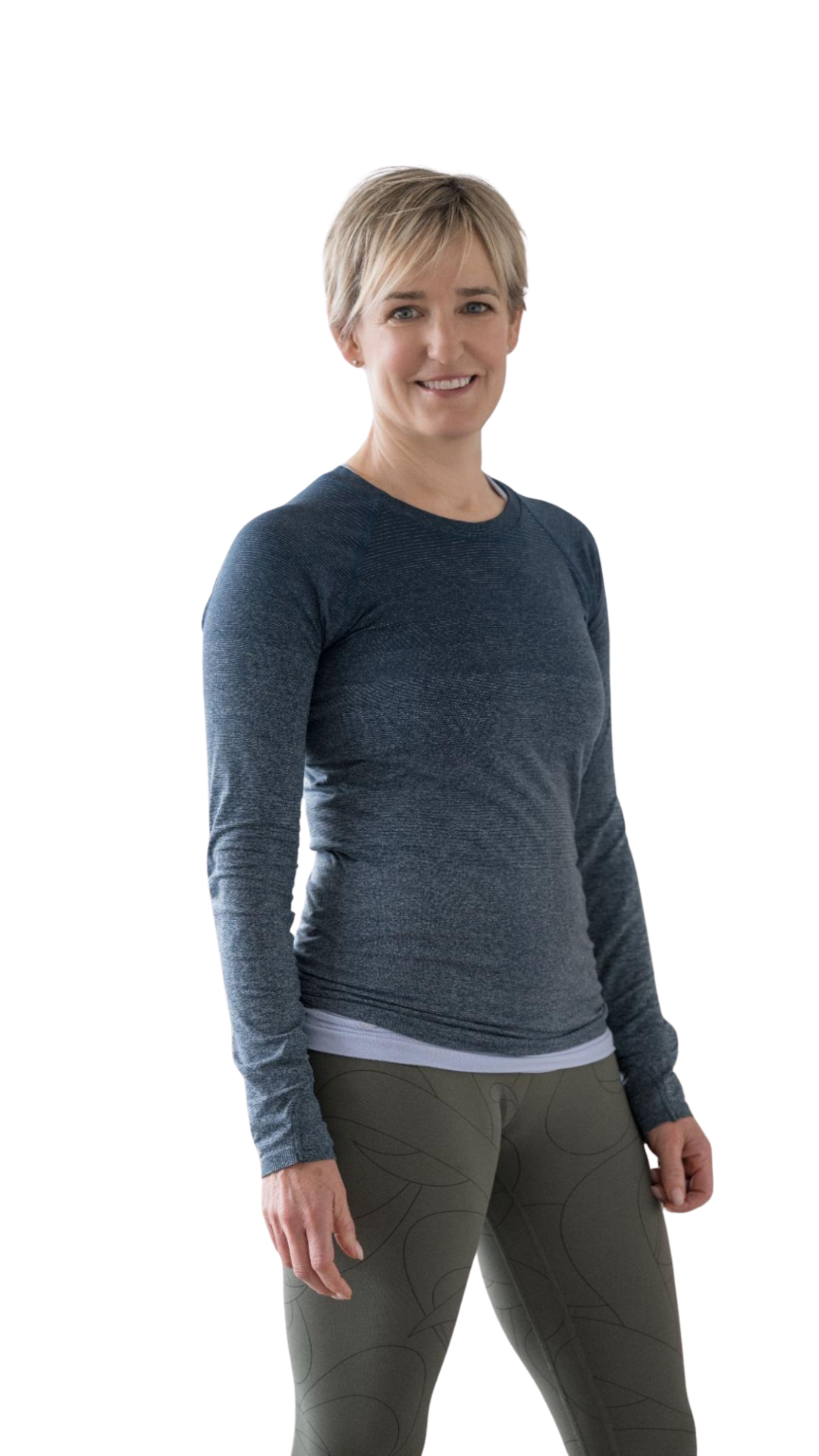
Your Instructor, Susi Hately, BSc. Kinesiology, C-IAYT Yoga Therapist
I’ve been helping people improve their walking for over 30 years. As the best-selling author of the Anatomy and Asana series and the Yoga for Anatomy DVD-ROM, my work has been featured in Yoga Journal, Real Simple, Natural Health, Yoga Therapy Today, Bridal Magazine, Chatelaine, and ACE Fitness.
Over the decades, by blending biomechanics and yoga, I’ve become a trusted bridge between medicine and yoga for two key reasons: first, I consistently help people reduce and eliminate physical pain; and second, I apply the same principles that have made me one of the most effective yoga therapists in North America to help yoga teachers do the same. Thousands of teachers have taken my yoga therapy trainings, and the results speak for themselves . . . they’re getting out of pain, walking with more ease, and helping their students do the same.
Here’s the Curriculum
Here’s the Curriculum
Here’s the Curriculum
01
The Biomechanics of Gait
Understand the key phases of gait and how they set the foundation for ease, balance, and efficiency.
02
Compensation Patterns
See the telltale signs of how the body works around pain, fatigue, or limping — and what those patterns reveal about the bigger picture.
03
Hip, Knee, Ankle, Foot… and the Rib Cage
Explore how each region contributes to walking, including the surprising role of the rib cage in stability and flow.
04
Walking’s Balancing Act
Go beyond “strength” or “alignment” to see how coordination and load transfer create stability when one foot is on the ground and the other is moving forward.
05
Absorbing Impact
Learn how impact moves through the whole body, and how to restore its natural shock-absorbing capacity.
06
Propulsion and Forward Motion
Discover how the body generates momentum and how to bring back power to every stride.
07
From Walking to Running
See how gait principles carry forward into running, what changes, and what stays the same.
By the end of this course, you’ll be able to:
Spot the patterns that actually drive a student’s limp, wobble, or hip hike.
Understand how different regions – from the feet to the rib cage – shape stability and ease in walking.
Teach practical strategies that improve stamina, balance, and confidence in every step.
Move past guessing and quick fixes, and guide your students with clarity you can trust.
How I Love Gait Works
This is an online program with both pre-recorded lessons and seven live training calls that we call Practice Labs.
You’ll also have access to a private discussion board on Circle, a place to ask questions, share insights, and connect with others learning alongside you.
- The recorded lessons give you structure and depth.
- The live calls give you interaction, clarity, and the chance to apply what you’re learning in real time.
- And the discussion board keeps you supported between sessions, so you’re never left figuring things out alone.
Course Dates: November 3-December 19.
Practice Labs
All call times are 10:15-11:15
- Monday November 3
- Wednesday November 5
- Monday November 17
- Wednesday November 19
- Tuesday November 25
- Tuesday December 9
- Tuesday December 16
Clarity for You. Confidence for Your Clients.
When you learn to see gait this way, something shifts, not just for your clients, but for you.
Instead of second-guessing yourself, you start trusting what you see.
You know what to look for, and you know how to respond.
Your clients feel that difference.
They sense your confidence.
They experience steadier strides, less fatigue, and more trust in their bodies.
And together, you move out of the loop of quick fixes and into real, lasting change.
This is where therapeutic yoga shines.
Not in piling on more poses or cues, but in refining how we observe, how we guide, and how we help the body rediscover its natural efficiency.
Frequently Asked Questions
Will it be Susi herself teaching the course, or will someone else teaching her content?
Yes, I am the one teaching.
Who is this course designed for?
Yoga teachers, yoga therapists and movement based practitioners who want up to date science AND how to integrate that science effectively into their classes and sessions.
Do I need a strong background in anatomy to join?
No. You don’t need to be an anatomy expert. You just need to be curious, open to learning, and ready to explore how the body moves and compensates in real time. We’ll cover the essentials in a way that’s accessible and immediately applicable.
Is this course appropriate if I’m already experienced in kinesiology or yoga therapy?
Yes. Many experienced teachers and even Certification grads join this program to refine how they see movement, integrate the latest science, and sharpen their teaching.
You’ll deepen your clarity, upgrade your tools, and likely “see” your clients in new ways.
What if I fall behind or can’t make a live call?
No problem. All calls are recorded and posted in your course space.
This course is designed to meet you where you are, and support you over time.
Does this course get me Continuing Education Credits?
Yes. We’re currently in the process of securing accreditation for this program with IAYT, and ACE.Many participants have also used our on demand course certificates to obtain CEUs with Physical Therapy and Occupational Therapy boards, as well as Pilates associations.We regularly apply for CEUs across our on-demand programs—so if you have a specific organization in mind, let us know and we’ll do our best to support you.
You will also be able to receive CEU’s for each year you are enrolled.
How do I access everything?
The course material, videos etc are all on Circle.